
Energy Efficiency / Customer Journey Stage 02 / Efficiency Default Filter
Efficiency Default Filter

Use this pattern to preselect the most efficient products by default, making energy efficiency the starting point of product discovery while preserving user choice.
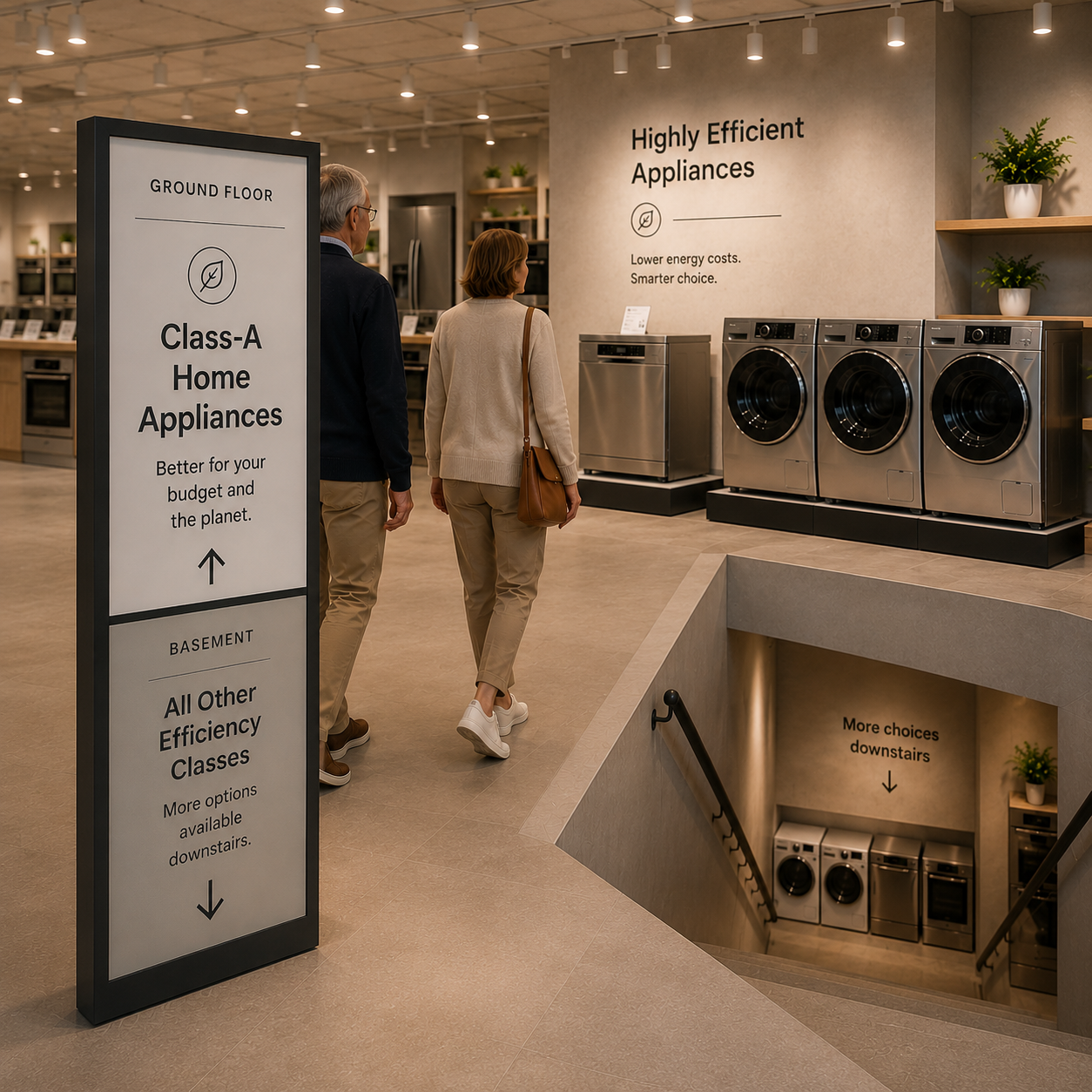
Why? The pattern reduces cognitive effort. Instead of asking users to actively search for efficient products, the interface presents them as the default option.
How it works

When users enter a product category, the highest efficiency class is already selected in the filter panel. Only Class A products are displayed. The next filter (B) is clearly visible, making the filtering logic transparent.

By selecting Class B, the product list expands to include both A and B products. Efficient products remain dominant while users gain access to a broader range of options.

Users can choose “Less efficient options” to expand the complete efficiency scale. Classes C–G become available as filter options.
Explore and download this pattern for free
Persona-Based Evaluation
Based on AI-assisted Personas

Committed Caretaker
Initial perception
Immediately notices that only the most efficient products are shown. The filter feels helpful rather than restrictive because it aligns with her existing priorities.
Interpretation
Understands the filter as a signal that the retailer actively supports responsible purchasing. The visible filter state creates transparency and trust.
Effect on decision
Reduces search effort
Increases trust in the retailer
Makes Class A products feel like the natural choice
Strengthens purchase confidence
Friction / risks
Low. She may explore lower classes out of curiosity, but is unlikely to disable the filter permanently.




Cross-Persona Evaluation
Perceptibility: Low to medium
The filter itself is visible when users look at the filter panel. However, many users never actively inspect filtering controls and focus directly on product cards. As a result, a substantial share of users may not realize that efficiency is shaping the product selection. In real-world retail environments with promotional banners, visibility is likely to be lower than in the prototype.
Comprehensibility: Medium to High
Users who notice the active filter generally understand it immediately. Filtering is a familiar e-commerce convention. The challenge is not understanding the mechanism but noticing that it is active in the first place.
Motivational Fit:
High: Committed Caretaker
Medium: Casual Conscious Consumer, Progressive Purchaser
Conditional: Savvy Economizer
Low: Novelty Seeker
Decision Impact: Potentially Strong, but Uneven
Among users who notice the filter, the effect can be substantial because products outside the selected efficiency classes simply never enter the evaluation process. Among users who do not notice the filter, the influence still exists, but cannot generate conscious motivation or trust. The pattern’s behavioural strength comes from reducing exposure to inefficient products rather than convincing users through information.
Risk of Backfire: Medium to High
This pattern represents one of the strongest interventions in the entire pattern collection because it actively removes products from view. The risk can be reduced through highly visible filter states, clear explanations and easy access to additional efficiency classes.
Expert Evaluation
Score: 7 / 14
**************
Cross-Expert Summary
Acceptance was mixed and strongly conditional. Some experts supported the idea where the platform already focuses on efficient products or where efficiency is part of the brand promise. Others rejected it because it hides parts of the assortment and may feel too directive.
The recurring condition is reversibility. Experts were more open to the pattern if users clearly understand that a filter is active and can easily remove it. Without transparency, the pattern risks being perceived as manipulative or commercially problematic.
“We would implement it, but only if it meets both criteria equally: efficiency and premium quality.”
— Lead UX Designer, Manufacturer
Project partners
Funding
Studio Peter Post × Petra Esveld
Studio Peter Post × Petra Esveld is a design studio focussing on ux- and service design for the circular economy and branding for public institutions, NGOs and Non-Profits.
Development

SwissEnergy
SwissEnergy is the Swiss Federal Council’s programme for supporting voluntary measures to improve energy efficiency and promote renewable energy.

Circular-Experience.org
Circular-Experience.org is the circular economy design practice of Studio Peter Post × Petra Esveld, specialising in service design and user experience design for sustainable products and systems.